How to go to confession: a step-by-step guide to the sacrament
To go to confession, examine your conscience, tell the priest your sins beginning “Bless me, Father, for I have sinned,” listen to his counsel, accept a penance, pray an act of contrition, and receive absolution. Here is how to go to confession, step by step, with the words to say.
Updated October 2, 202611 min read
In short
- Catholic confession, the Sacrament of Reconciliation, has three acts of the penitent — contrition, confession and satisfaction — followed by the priest’s absolution (CCC 1491).
- Prepare with an examination of conscience, then find a confession time at a nearby parish or ask a priest for an appointment.
- Begin, “Bless me, Father, for I have sinned. It has been … since my last confession,” then tell your sins simply and honestly.
- After your confession the priest gives counsel and a penance; you pray an act of contrition, and he absolves you in the name of the Father, the Son and the Holy Spirit.
- Everything you say is protected by the seal of confession, which binds the priest to absolute secrecy with no exceptions (CCC 1467).
On this page
- What is confession, and why go?
- Before you go: examine your conscience and find a time
- How to go to confession, step by step
- What to say in confession
- The act of contrition to pray
- Is everything I say in confession kept secret?
- What is the penance, and do I have to do it?
- After confession, and what if you are nervous or forget
- Common questions
What is confession, and why go?
Catholic confession, also called the Sacrament of Penance or Reconciliation, is the sacrament in which you tell your sins to a priest, are truly sorry for them, and receive God’s forgiveness through his absolution. The Church teaches that the risen Christ gave his apostles this power on Easter evening: “Whose sins you shall forgive, they are forgiven them” (John 20:23). Bishops and priests continue that ministry today (CCC 1461).
People go to confession because it restores friendship with God and brings “peace and serenity of conscience” (CCC 1468). Any baptized Catholic may go, and the Church asks every Catholic to confess serious sin at least once a year (CCC 1457). You do not need to be a saint to go, or to have the perfect words. You need only honesty and the desire to begin again. The priest is there to help, not to judge you.
Before you go: examine your conscience and find a time
Before confession, make an examination of conscience: a quiet, honest look at your life in the light of God’s word (CCC 1454). Most people examine themselves by the Ten Commandments, asking where they have sinned in thought, word, action and what they failed to do. Our examination of conscience gives questions for adults; you can also read our list of sins to confess. Fifteen minutes is usually enough. Some people write a short list to bring with them.
Then find a time. Most parishes hear confessions weekly, often on Saturday afternoon or before Mass; check your parish website or bulletin for the hours. You can also telephone the parish office and ask for an appointment — priests are glad to make time, especially if it has been years. In Advent and Lent, and at retreats, many parishes hold penance services.
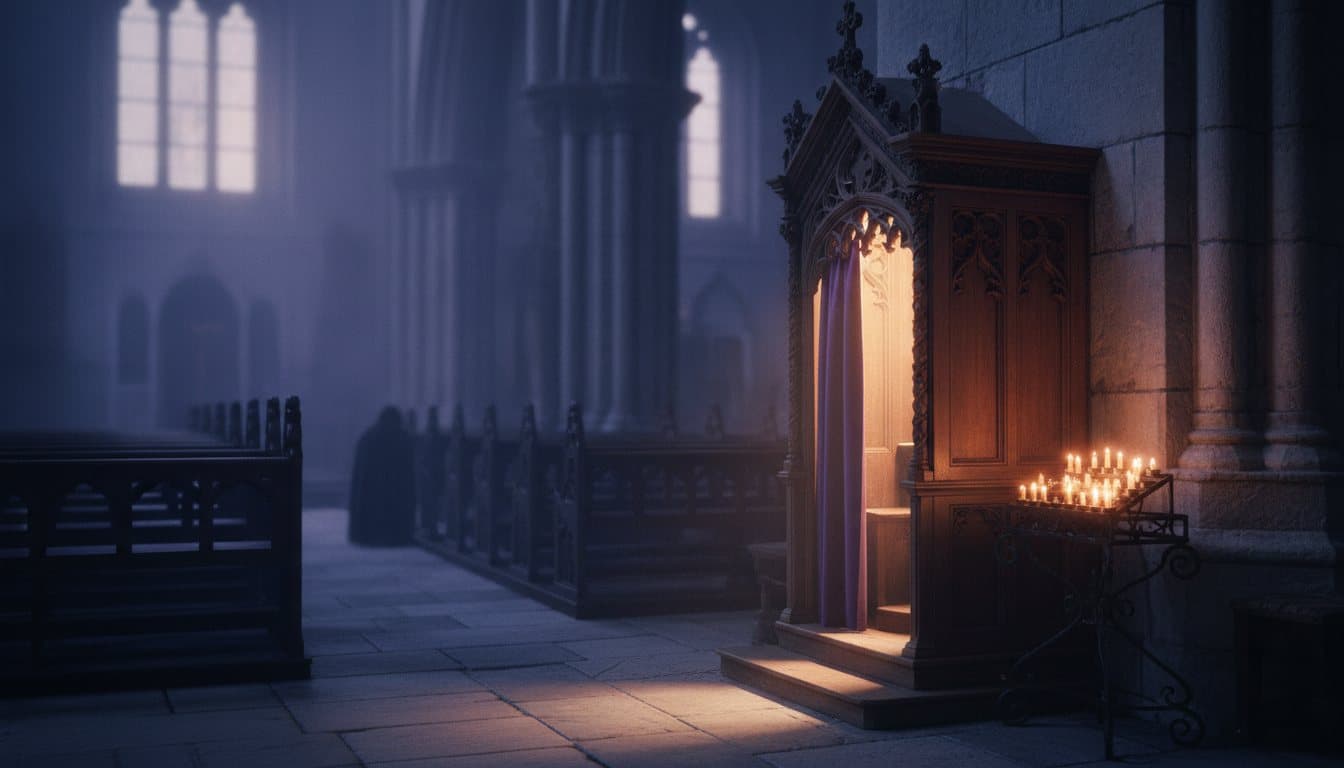
You may confess face to face or behind a screen, and the choice is yours. In most churches the confessional has both: a kneeler behind a grille where you stay anonymous, and a chair where you sit and speak with the priest directly. Neither is holier than the other. Choose whichever helps you be honest and at peace.
How to go to confession, step by step
The steps of confession are always the same, whatever words you use. The Church describes them as a greeting and a reading, then your confession, a penance, your act of contrition and the priest’s absolution, ending with thanksgiving and a blessing (CCC 1480). Here is how it goes, in order.
Enter and greet the priest
Go in when it is your turn. The priest may welcome you and invite you to begin. Many people and the priest make the sign of the cross together.
Begin with the opening words
Say: “Bless me, Father, for I have sinned. It has been [a week / six months / ten years] since my last confession.” If you cannot remember exactly, say roughly how long it has been.
Confess your sins
Tell your sins simply and honestly. Name every mortal sin you remember, and roughly how often; you may add the venial sins that trouble you. If you are unsure how to say something, the priest will help.
Listen to the priest’s counsel
When you have finished, you can say, “For these and all the sins of my past life, I am sorry.” The priest may offer a few words of encouragement or advice.
Accept your penance
The priest gives you a penance — usually a prayer or a good act — to help repair the harm of sin and grow in grace (CCC 1460). Remember it, and do it afterwards.
Pray an act of contrition
The priest asks you to express your sorrow. Pray an act of contrition aloud — the traditional prayer, or simple words of your own.
Receive absolution
The priest extends his hand and prays the prayer of absolution, ending, “I absolve you from your sins in the name of the Father, and of the Son, and of the Holy Spirit.” You answer, “Amen.”
Go in peace
He may say, “Give thanks to the Lord, for he is good,” and dismiss you. Your sins are forgiven. Leave, and do your penance.
What to say in confession
What to say in confession is simpler than most people fear. After the sign of the cross you begin with the opening words, then say your sins plainly. You do not need churchy language or long explanations — only what you did and, for serious sins, roughly how often. The priest is bound to secrecy and has heard everything before; you cannot shock him.
The customary opening is: “Bless me, Father, for I have sinned. It has been … since my last confession.” Then confess your sins. When you have finished, a traditional way to close is: “For these and all the sins of my past life, I am sorry.” That tells the priest you are done and asks for mercy, including for sins you cannot now recall.
Receive ye the Holy Ghost. Whose sins you shall forgive, they are forgiven them; and whose sins you shall retain, they are retained.
You must confess every mortal sin you remember after examining your conscience, naming its kind and how many times (CCC 1456). Confessing venial sins is not required, but the Church strongly recommends it (CCC 1458). If you are unsure whether a sin was mortal, simply tell the priest and let him guide you — never try to judge the state of your own soul alone. Our guide to what to say when a sin is hard to name can help you find the words.
The act of contrition to pray
Near the end, the priest asks you to express your sorrow by praying an act of contrition. You can use simple words of your own, or the traditional prayer below, which many Catholics know by heart. Bring it on a card if you are not sure you will remember it; priests expect that, and often have a copy to hand.
O my God, I am heartily sorry for having offended Thee,
and I detest all my sins, because I dread the loss of heaven and the pains of hell;
but most of all because they offend Thee, my God,
who art all good and deserving of all my love.
I firmly resolve, with the help of Thy grace,
to confess my sins, to do penance, and to amend my life.
Amen.
The traditional English Act of Contrition (the Baltimore Catechism form), public domain. A common variant ends, “to sin no more and to avoid the near occasions of sin.” Our act of contrition guide has more forms and what each line means.
Is everything I say in confession kept secret?
Yes. Everything you confess is protected by the seal of confession, and the protection is absolute. The Church binds every priest who hears confessions, “under very severe penalties, to keep absolute secrecy regarding the sins” confessed to him; this seal “admits of no exceptions” (CCC 1467). Canon law states the same: “The sacramental seal is inviolable” (canon 983). A priest may never reveal what he hears, to anyone, for any reason, even at the cost of his life.
The priest also cannot use what he learns in confession, or let it change how he treats you outside it. This is why you can be completely honest. If naming a sin aloud feels frightening, you can tell the priest that first; he will help you say it. The freedom of the seal is one of the great mercies of this sacrament.
What is the penance, and do I have to do it?
The penance is the prayer or good act the priest gives you to do after confession. Absolution takes away your sin, but a penance helps repair the damage sin causes and restores your spiritual health (CCC 1459). It should fit the sins confessed and your situation, and may be a few prayers, an act of charity, or a small sacrifice (CCC 1460). Do it as soon as you reasonably can, so you do not forget.
Where your sin has harmed someone, the penance is not the whole of it: simple justice asks you to make amends where you can — return what was taken, repair a reputation, say sorry (CCC 1459). If the penance is unclear, or you cannot do it, ask the priest before you leave, or speak to any priest afterwards. Doing your penance is part of the sacrament, but forgetting it in good faith does not undo the forgiveness you received.
After confession, and what if you are nervous or forget
After confession, do your penance and rest in the peace of being forgiven. Many people pray a few minutes of thanksgiving, read a psalm, or simply sit quietly. You might choose one thing to change, and one habit to build. Our guide on how to repent helps turn a good confession into a lasting change of heart.
If you are nervous, that is normal, and it passes. Tell the priest, “I am nervous, and it has been a while” — he hears this often and will slow down for you. If you forget a sin, do not worry: a sin forgotten in good faith is forgiven with the rest, and if you remember a mortal sin later, just mention it next time. There is no way to “do it wrong” if you come honestly.
Common questions
What do you say when you go to confession?
Begin with the sign of the cross and say, “Bless me, Father, for I have sinned. It has been six months since my last confession,” giving your own length of time. Then tell your sins simply, naming any mortal sins and roughly how often. When you finish you can add, “For these and all the sins of my past life, I am sorry.” The priest gives counsel and a penance, you pray an act of contrition, and he absolves you.
How often should a Catholic go to confession?
The Church requires every Catholic to confess serious sin at least once a year, and you must not receive Holy Communion while conscious of a mortal sin without first going to confession. Many Catholics go monthly, because regular confession of everyday faults forms the conscience and helps you grow. Go whenever you are aware of mortal sin, and as often as you find it helpful for venial sins.
What if I can’t remember all my sins?
Do your best to examine your conscience honestly, then confess what you remember. A sin you forget in good faith is forgiven along with the rest; the absolution is not undone. If you later remember a mortal sin you overlooked, simply mention it at your next confession. Deliberately hiding a mortal sin is different, so if you are afraid to name something, tell the priest and let him help you.
Should I go to confession face to face or behind the screen?
Either is fine, and the choice is yours. Most confessionals offer both: a screen where you remain anonymous, and a chair where you speak with the priest directly. Neither is more valid or more holy. Choose whichever helps you be honest and at peace. If you are anxious, the screen can feel safer; if you want a conversation, face to face may help more.
Is everything I say in confession really confidential?
Yes, completely. The seal of confession binds the priest to absolute secrecy about everything you confess, with no exceptions and for any reason, even under threat to his own life (CCC 1467; canon 983). He may never repeat it or act on it outside confession. This is why you can speak freely. If naming something aloud frightens you, tell the priest that first and he will help you say it.
What if it has been many years since my last confession?
You are very welcome back, and priests especially love these confessions. Just say at the start, “It has been many years, and I’m not sure of the steps.” The priest will guide you through everything and help you examine your conscience. You do not need to remember every detail of the years; name the serious sins you recall and be honest about the rest. Expect to leave with great peace.
Sources
Cited by paragraph and verse, so you can read them in full. In the end, your priest has the final word.
- Catechism of the Catholic Church, 1422–1424
- Catechism of the Catholic Church, 1450–1460
- Catechism of the Catholic Church, 1461–1467
- Catechism of the Catholic Church, 1468–1470
- Catechism of the Catholic Church, 1480–1484
- Catechism of the Catholic Church, 1491
- John 20:19–23
- Luke 15:11–32 (the prodigal son)
- Code of Canon Law, canons 959–991 (the seal, canon 983; yearly confession, canon 989)
Confession Compass is an independent educational tool, not an official body of the Catholic Church. It never absolves sins: only a priest, in the Sacrament of Reconciliation, can absolve.
Keep reading

Examination of conscience: how to prepare for Confession
An examination of conscience for adults, by the Ten Commandments: what it is, how to make one in fifteen minutes, and the questions to ask before Confession.
The Act of Contrition: the prayer, its meaning, and how to pray it
The act of contrition is the prayer of sorrow for sin said in confession. Read the traditional act of contrition in full, with its meaning and how to pray it.

Confession after many years: how to go back
Going to confession after many years? You are welcome back. Here is how to prepare, what to say, and what to expect when it has been a long time.